KLOW
Also known as: GHK-Cu / BPC-157 / TB-500 / KPV blend, Four-peptide repair blend
A four-peptide blend combining GHK-Cu, BPC-157, TB-500 and KPV — each with its own literature, none studied in combination.
Jump to notable studies ↓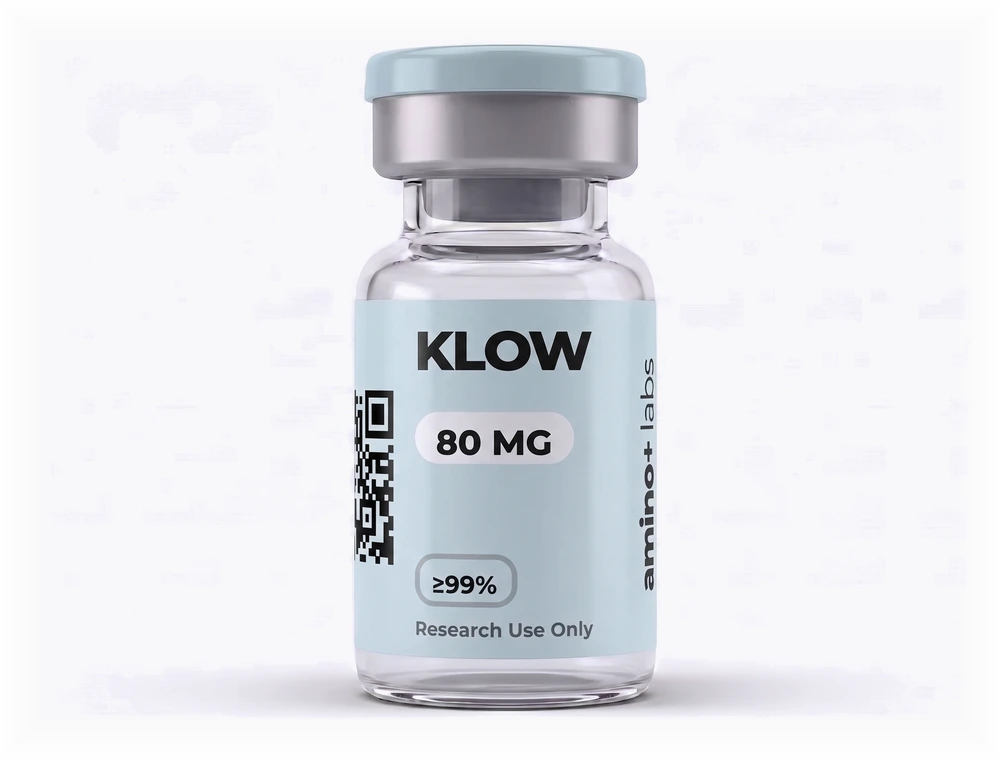
Molecular Data
- Class
- Multi-peptide research blend (GHK-Cu, BPC-157, TB-500, KPV)
- Molecular Weight
- Varies by component
- Molecular Formula
- Blend — see the individual component entries for molecular data
- Half-Life
- Varies by component; no pharmacokinetic data exist for the combination
Mechanism of Action
KLOW is a formulation, not a molecule. No published study has examined these four peptides administered together, so there is no combination pharmacology to report and no basis for claiming additive or synergistic effects. What follows is the mechanism of each component, studied separately.
- GHK-Cu — a copper-binding tripeptide (Gly-His-Lys) that delivers Cu(II) and has been studied for effects on collagen synthesis, extracellular matrix remodelling, and gene expression in dermal fibroblasts. See the GHK-Cu entry.
- BPC-157 — a pentadecapeptide from gastric juice studied for angiogenesis via VEGF/VEGFR2 upregulation, nitric-oxide-system modulation, and collagen synthesis in rodent tendon and ligament models. See the BPC-157 entry.
- TB-500 — the synthetic fragment corresponding to the actin-binding region of thymosin β4, studied for actin sequestration, cell migration, and angiogenesis. See the TB-500 entry.
- KPV — the C-terminal tripeptide of α-MSH (Lys-Pro-Val). Dalmasso and colleagues showed it is taken into intestinal epithelial and immune cells by the di/tripeptide transporter PepT1, where it suppresses NF-κB signalling and pro-inflammatory cytokine expression.
The four components target different systems — matrix remodelling, angiogenesis, cytoskeletal dynamics, and inflammatory signalling. That is the rationale behind the formulation. It is a rationale, not a finding.
Research History
Each component has its own independent research history, summarised on its own page in this library. The blend itself does not.
Multi-peptide research blends of this kind emerged from the compounding and research-supply market rather than from a published development programme. There is no preclinical characterisation of KLOW as a composition, no pharmacokinetic data on the mixture, and no study of how the four peptides behave in the same vial or the same preparation.
Two practical consequences follow for anyone designing work with this material. First, any result obtained with the blend cannot be attributed to a single component without running the components separately as controls. Second, the component ratio is a property of the specific formulation, not a standard — published work on any individual peptide used a different concentration in a different vehicle.
Notable Studies
Dalmasso G, Charrier-Hisamuddin L, Nguyen HTT, Yan Y, Sitaraman S, Merlin D. · Gastroenterology
The principal mechanistic paper on KPV, the one component of this blend without its own entry in this library. Showed PepT1-mediated uptake into intestinal epithelial and immune cells, suppression of NF-κB signalling, and reduced pro-inflammatory cytokine expression in DSS- and TNBS-induced colitis models.
Related Peptides
GHK-Cu
A naturally occurring copper-binding tripeptide studied for its roles in collagen synthesis, tissue remodeling, and antioxidant activity.
BPC-157
A stable 15-amino acid gastric peptide studied for tissue repair and cytoprotection.
TB-500
A synthetic form of Thymosin Beta-4, a ubiquitous actin-sequestering protein studied for wound healing and tissue regeneration.
Wolverine (BPC + TB)
A two-peptide blend of BPC-157 and TB-500, the most commonly paired combination in tissue-repair research literature.