GHK-Cu
Also known as: Copper Tripeptide-1, Gly-His-Lys-Cu(II), Prezatide Copper
A naturally occurring copper-binding tripeptide studied for its roles in collagen synthesis, tissue remodeling, and antioxidant activity.
Jump to notable studies ↓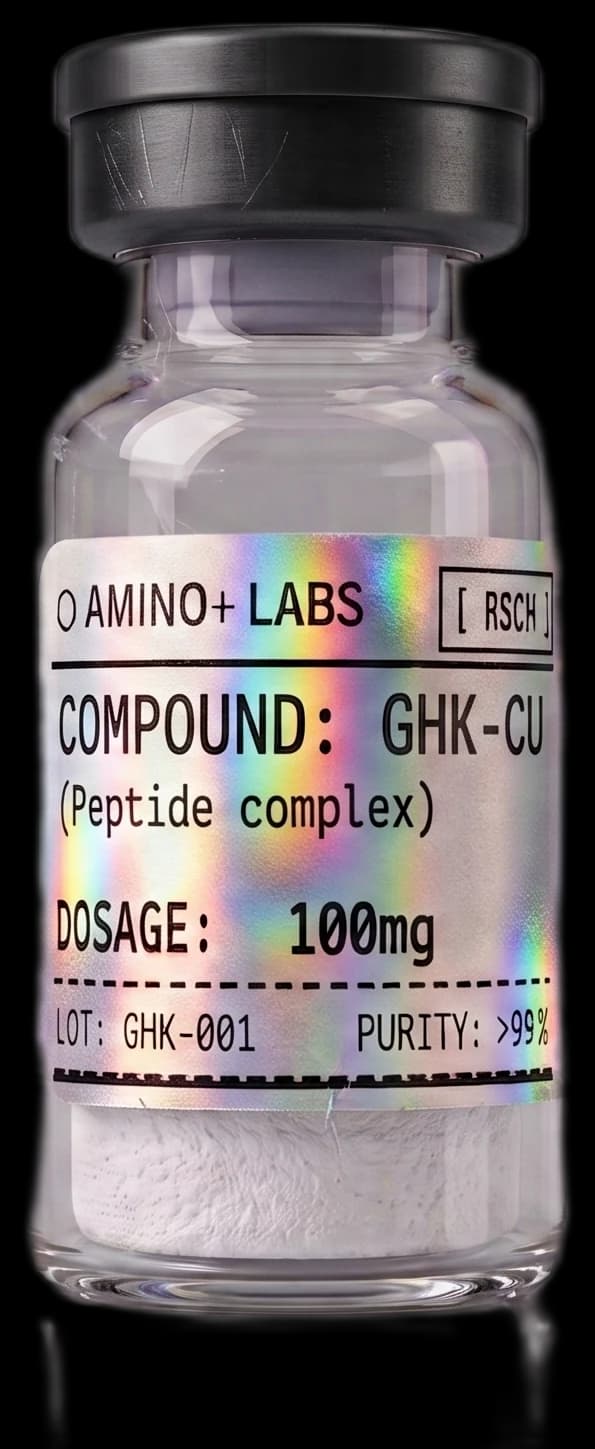
Molecular Data
- Class
- Copper-binding tripeptide / Tissue-remodeling and antioxidant peptide
- Molecular Weight
- ~403 Da (peptide–copper complex)
- Molecular Formula
- C₁₄H₂₄N₆O₄Cu
- Half-Life
- Short in circulation (estimated); locally applied or injected forms are studied over multi-week protocols
- Sequence / Structure
- Gly-His-Lys, complexed with Cu(II)
Mechanism of Action
GHK-Cu is a tripeptide (glycyl-L-histidyl-L-lysine) with a high-affinity copper(II) binding site, first isolated from human plasma. It occurs naturally in the body but declines with age, which has motivated much of the research interest in its tissue-remodeling effects.
- Copper delivery and cellular transport: GHK-Cu binds copper ions and facilitates their uptake by cells, supporting copper-dependent enzymes including lysyl oxidase (required for collagen and elastin crosslinking) and superoxide dismutase (an antioxidant enzyme).
- Collagen and elastin synthesis: Research indicates GHK-Cu stimulates production of collagen types I, III, and VII, enhances elastin synthesis, and increases glycosaminoglycan production — the structural basis for its study in skin and connective tissue research.
- Matrix remodeling: GHK-Cu has been shown to upregulate tissue inhibitors of metalloproteinases (TIMPs) while modulating matrix metalloproteinase (MMP) activity, a balance implicated in wound healing and tissue turnover.
- Antioxidant activity: GHK-Cu scavenges free radicals and upregulates antioxidant enzyme expression, studied as a mechanism protecting tissue from oxidative damage.
- Gene expression effects: Genomic studies have found that GHK-Cu influences expression of a large number of genes associated with tissue repair and regeneration, and it has been reported to promote stem cell proliferation in vitro.
Research History
GHK-Cu was first identified in human plasma in the 1970s by Loren Pickart, who observed that plasma from younger individuals had a greater capacity to stimulate liver cell growth in culture than plasma from older individuals — an effect later traced to GHK-Cu. Circulating GHK-Cu levels have since been reported to decline substantially with age.
Subsequent decades of research, much of it led by Pickart and collaborators, characterized GHK-Cu's effects on collagen synthesis, wound healing, and gene expression, including genomic profiling studies identifying broad transcriptional effects on genes involved in tissue repair. Early biochemistry established the structure of the tripeptide–copper(II) complex (Freedman et al., 1982) and characterized its high-affinity copper binding (Lau & Sarkar, 1981). Maquart, Pickart and colleagues (1988) provided the first biochemical evidence that GHK-Cu directly stimulates collagen synthesis in fibroblast cultures; a follow-up in vivo study in rat experimental wounds (Maquart et al., 1993) extended these findings to connective-tissue accumulation in a wound model.
Since the early 2000s, GHK-Cu has been most extensively studied in dermatological and cosmetic research, where it is a common ingredient in topical formulations studied for skin firmness, wrinkle appearance, and wound healing in laboratory models. Research has also examined hair-follicle and systemic applications, and more recent work has explored its neuroprotective and antifibrotic activities in cell and animal models. As with most cosmeceutical peptides, most published human data comes from smaller clinical and observational studies rather than large randomized controlled trials.
Notable Studies
Maquart FX, Pickart L, Laurent M, Gillery P, Monboisse JC, Borel JP. · FEBS Letters
Foundational in vitro study showing that GHK-Cu directly stimulates collagen synthesis in cultured fibroblast monolayers and floating collagen lattices — the earliest mechanistic basis for later tissue-remodeling research.
Maquart FX, Bellon G, Chaqour B, Wegrowski J, Patt LM, Trachy RE, Monboisse JC, Chastang F, Birembaut P, Gillery P. · Journal of Clinical Investigation
In vivo study in rat experimental wounds demonstrating that GHK-Cu stimulates connective-tissue accumulation, providing the first in vivo evidence that the in vitro fibroblast effects translate to tissue remodeling in a wound model.
Siméon A, Monier F, Emonard H, Gillery P, Birembaut P, Hornebeck W, Maquart FX. · Journal of Investigative Dermatology
Study of GHK-Cu's modulation of matrix metalloproteinase expression and activation during wound healing, supporting a role for the tripeptide–copper complex in the balance of matrix synthesis and degradation studied in dermal tissue.
Pollard JD, Quan S, Kang T, Koch RJ. · Archives of Facial Plastic Surgery
Study of GHK-Cu's effects on proliferation and growth-factor expression in normal and irradiated fibroblasts, exploring the tripeptide–copper complex's potential to support fibroblast activity in irradiated tissue models.
Badenhorst T, Svirskis D, Wu Z. · Pharmaceutical Development and Technology
Preformulation study characterizing the physicochemical properties of native GHK tripeptide relevant to dermal delivery formulations studied for wound-healing and skin research applications.
Pickart L, Vasquez-Soltero JM, Margolina A. · BioMed Research International
Review of genomic and cell-culture studies characterizing GHK-Cu's effects on gene expression pathways related to collagen production, wound healing, and antioxidant defense.
Pickart L, Vasquez-Soltero JM, Margolina A. · Brain Sciences
Genomic analysis of GHK's influence on genes related to nervous system function and cognitive decline, situating the tripeptide within broader tissue-maintenance research beyond skin and connective tissue.
Pickart L, Margolina A. · International Journal of Molecular Sciences
Review integrating newer transcriptomic data with prior biochemical research on GHK-Cu, summarizing its documented effects on genes implicated in tissue regeneration, antioxidant defense, and cellular maintenance.
Min JH, Sarlus H, Harris RA. · Metallomics
Recent in vitro study showing that GHK can prevent metal-induced protein aggregation and cell death in CNS cell models — adding to research interest in the tripeptide's neuroprotective properties.