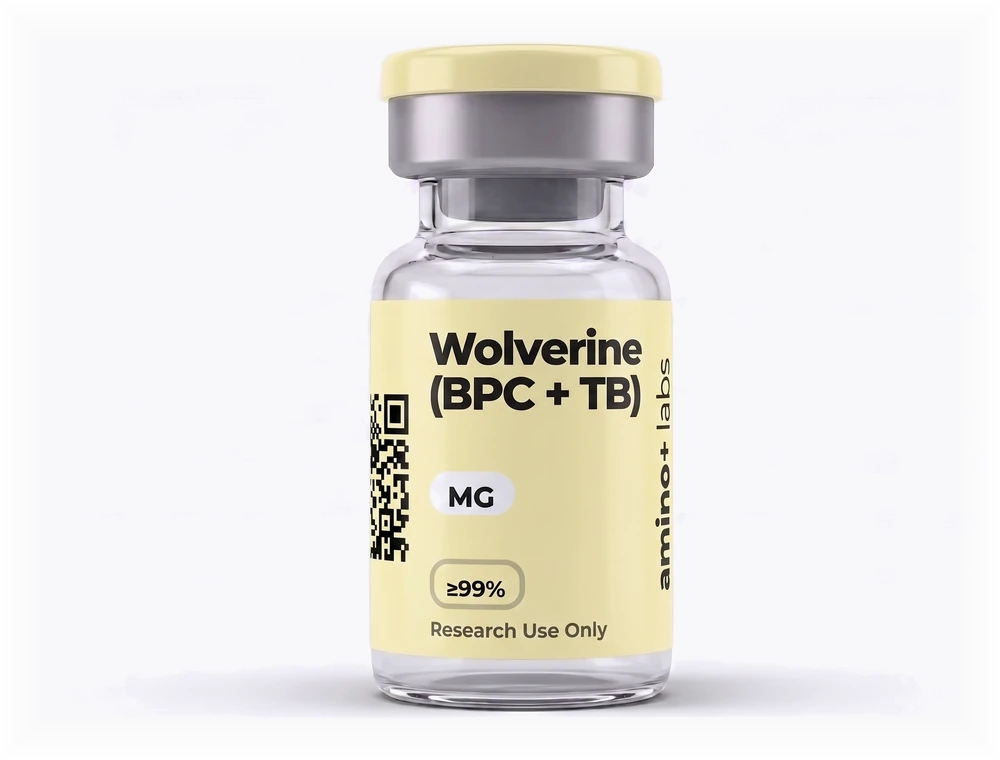
Wolverine (BPC + TB)
Also known as: BPC-157 / TB-500 blend, Wolverine blend
A two-peptide blend of BPC-157 and TB-500, the most commonly paired combination in tissue-repair research literature.
Molecular Data
- Class
- Two-peptide research blend (BPC-157, TB-500)
- Molecular Weight
- Varies by component
- Molecular Formula
- Blend — see the BPC-157 and TB-500 entries for molecular data
- Half-Life
- Varies by component; no pharmacokinetic data exist for the combination
Mechanism of Action
Like any blend, this is a formulation rather than a compound. BPC-157 and TB-500 are frequently discussed together because their reported mechanisms operate on different parts of the same process, but the pairing itself has not been characterised in a published study.
- BPC-157 acts on the vascular and matrix side: upregulation of VEGF and VEGFR2 driving angiogenesis at injury sites, modulation of the nitric oxide–prostaglandin pathway, stimulation of collagen synthesis and fibroblast proliferation, and downregulation of NF-κB signalling. It is notably stable against proteolysis and gastric acid.
- TB-500 acts on the cytoskeletal side: it corresponds to the actin-binding region of thymosin β4 and sequesters G-actin, influencing actin polymerisation dynamics that underlie cell migration — including migration of endothelial cells and keratinocytes into a wound bed.
The combination is described in the supply literature as pairing angiogenesis with cell migration. That description is a reading of two separate literatures, not a result from a combination study. Full mechanism detail for each is on the BPC-157 and TB-500 pages.
Research History
BPC-157 was described by Sikirić and colleagues at the University of Zagreb from the 1990s onward; thymosin β4 and its actin-binding fragment have a separate literature running from the 1980s. Both histories are covered on the component pages.
What does not exist is a history for the pairing. No published trial, and no preclinical study we are aware of, has administered these two peptides together as a defined combination with the appropriate single-agent control arms. The pairing is a market convention.
For research design, that means the blend is best treated as a convenience format rather than as a studied intervention: it saves a reconstitution step, and it forecloses the ability to attribute any observation to one peptide or the other.
Related Peptides
BPC-157
A stable 15-amino acid gastric peptide studied for tissue repair and cytoprotection.
TB-500
A synthetic form of Thymosin Beta-4, a ubiquitous actin-sequestering protein studied for wound healing and tissue regeneration.
KLOW
A four-peptide blend combining GHK-Cu, BPC-157, TB-500 and KPV — each with its own literature, none studied in combination.