Melanotan-1
Also known as: Afamelanotide, [Nle⁴, D-Phe⁷]-α-MSH, NDP-α-MSH, MT-1
A protease-resistant analogue of α-melanocyte-stimulating hormone studied for melanocortin-1 receptor agonism and eumelanin synthesis.
Jump to notable studies ↓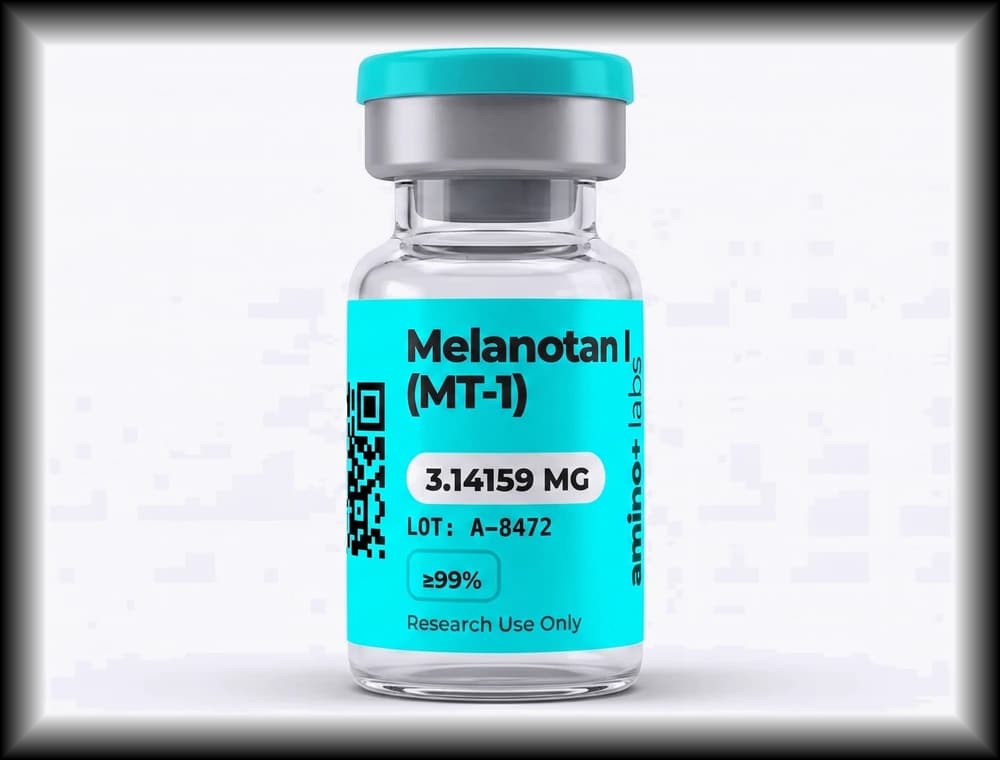
Molecular Data
- Class
- Cyclic-free linear tridecapeptide / Melanocortin receptor agonist (α-MSH analogue)
- Molecular Weight
- 1,646.85 Da
- Molecular Formula
- C₇₈H₁₁₁N₂₁O₁₉
- Half-Life
- Substantially longer than native α-MSH; the implant formulation releases over several days
- Sequence / Structure
- Ac-Ser-Tyr-Ser-Nle-Glu-His-D-Phe-Arg-Trp-Gly-Lys-Pro-Val-NH₂ (N-terminal acetyl, C-terminal amide; Nle = norleucine)
Mechanism of Action
Melanotan-1 is a 13-amino-acid analogue of α-melanocyte-stimulating hormone (α-MSH) carrying two substitutions: norleucine replaces methionine at position 4, and D-phenylalanine replaces L-phenylalanine at position 7.
- Resistance to proteolysis: The D-amino acid at position 7 blocks cleavage by serum peptidases that rapidly degrade native α-MSH, which is the direct cause of the analogue's prolonged activity.
- Melanocortin-1 receptor agonism: Binding MC1R on melanocytes raises intracellular cAMP, upregulating tyrosinase and driving synthesis of eumelanin — the darker, more photoprotective of the two melanin types.
- Photoprotection rather than sunscreen action: Eumelanin absorbs and dissipates incident light within the skin. Research applications rest on that endogenous pigment rather than on any topical barrier.
- Broader melanocortin activity: Like α-MSH itself, the analogue has affinity for other melanocortin receptor subtypes, which is why the structurally related but distinct Melanotan-II shows a markedly different effect profile.
Melanotan-1 and Melanotan-II are frequently confused. They are different molecules with different receptor selectivity; results reported for one do not transfer to the other.
Research History
The molecule originates in the structure-activity work of Sawyer, Hruby, Hadley and colleagues at the University of Arizona, published in PNAS in 1980. They reported that [Nle⁴, D-Phe⁷]-α-MSH resisted enzymatic degradation and was roughly 26 times as potent as native α-MSH in the melanoma adenylate cyclase assay, describing its biological activity as "ultralong".
Development as afamelanotide focused on erythropoietic protoporphyria (EPP), a rare photodermatosis in which patients experience severe phototoxic pain on light exposure. Langendonk and colleagues published two multicentre, randomised, double-blind, placebo-controlled trials in the New England Journal of Medicine in 2015, using subcutaneous implants containing 16 mg of afamelanotide, and reported improved tolerance to sunlight and improved quality of life with an acceptable side-effect profile.
Afamelanotide was subsequently approved for EPP in the European Union and, in 2019, by the FDA. That approval covers a specific implant formulation for a rare disease under specialist supervision; it does not extend to the peptide as sold for laboratory research.
Notable Studies
Sawyer TK, Sanfilippo PJ, Hruby VJ, Engel MH, Heward CB, Burnett JB, Hadley ME. · Proceedings of the National Academy of Sciences USA
The original synthesis and characterisation. Reported resistance to serum enzyme degradation and roughly 26-fold greater potency than α-MSH in the melanoma adenylate cyclase assay, confirmed across frog skin bioassay and melanoma tyrosinase activity.
Langendonk JG, Balwani M, Anderson KE, et al. · New England Journal of Medicine
Two multicentre, randomised, double-blind, placebo-controlled trials of 16 mg subcutaneous afamelanotide implants in EPP. Reported increased tolerance of sunlight, reduced phototoxicity, and improved quality of life.