DSIP
Also known as: Delta Sleep-Inducing Peptide, Delta EEG-inducing peptide
A nonapeptide isolated from cerebral venous blood during induced sleep, studied for delta-wave EEG effects and neuroendocrine modulation.
Jump to notable studies ↓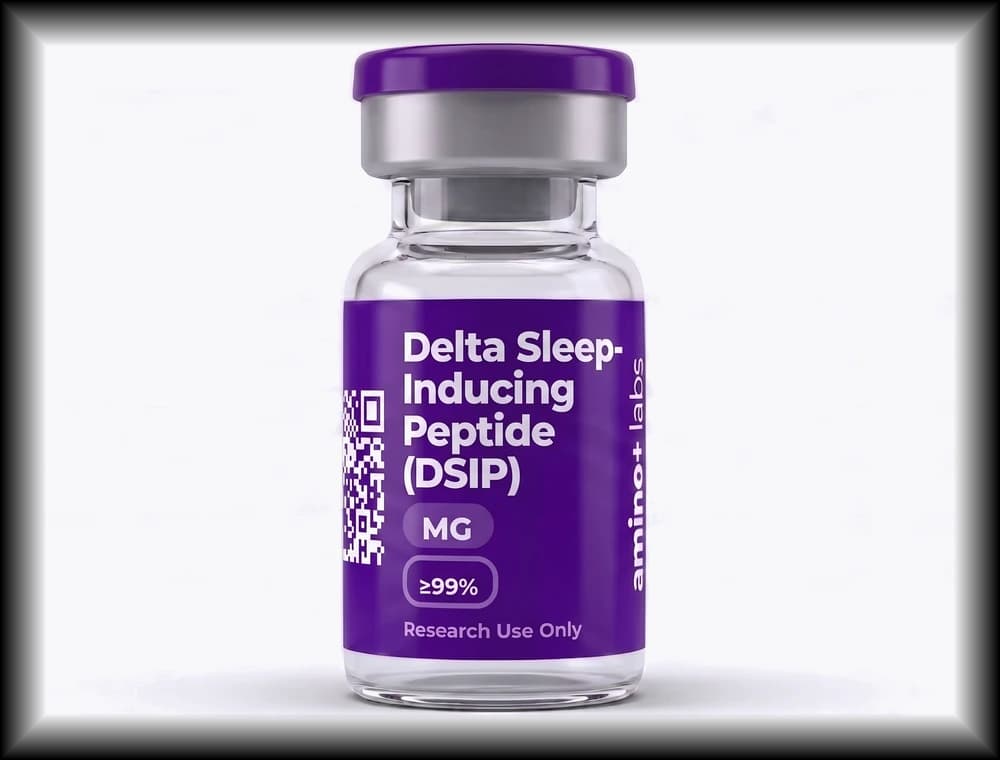
Molecular Data
- Class
- Nonapeptide / Neuropeptide of undetermined receptor target
- Molecular Weight
- 848.81 Da
- Molecular Formula
- C₃₅H₄₈N₁₀O₁₅
- Half-Life
- Minutes in plasma — DSIP is rapidly degraded
- Sequence / Structure
- Trp-Ala-Gly-Gly-Asp-Ala-Ser-Gly-Glu (WAGGDASGE)
Mechanism of Action
DSIP is unusual among well-known research peptides in that its receptor has never been identified. Nearly fifty years after isolation, no specific DSIP binding site has been cloned or characterised, so the mechanism is described in terms of observed effects rather than a defined signalling pathway.
- Delta-wave EEG activity: The defining observation is a prolongation of slow-wave (delta) EEG activity following intraventricular infusion in rabbits, which is what the peptide is named for.
- Blood-brain barrier transport: A saturable transport mechanism for DSIP at the blood-brain barrier has been described, indicating carrier-mediated rather than purely passive entry.
- Neuroendocrine modulation: Reported effects extend beyond sleep to pituitary hormone release, pineal N-acetyltransferase activity, and stress-response measures — the basis for describing DSIP in the review literature as multifunctional.
- Rapid degradation: DSIP is short-lived in plasma, which complicates attributing observed effects to the intact peptide rather than to fragments.
The literature is genuinely unresolved. A 2006 review in the Journal of Neurochemistry characterised DSIP as "a still unresolved riddle", and that remains a fair summary.
Research History
DSIP was isolated by Schoenenberger and Monnier at the University of Basel. Working with rabbits under hypnogenic electrical stimulation of the intralaminar thalamic area, they collected the extracorporeal dialysate of cerebral venous blood and purified from it a factor that induced slow-wave EEG activity when infused into the ventricles of recipient animals. Amino-acid analysis and sequencing gave Trp-Ala-Gly-Gly-Asp-Ala-Ser-Gly-Glu, published in PNAS in 1977.
The same programme synthesised the nonapeptide along with five candidate metabolic fragments, two substituted analogues, and a related tripeptide, testing all nine under double-blind conditions in rabbits — unusually rigorous for peptide work of that period.
Through the 1980s, Graf, Kastin and others catalogued a widening range of reported effects, and the review literature shifted from treating DSIP as a sleep factor to treating it as a multifunctional peptide of uncertain identity. Human data remain limited and older, and DSIP has never been developed as an approved drug in any jurisdiction.
Notable Studies
Schoenenberger GA, Monnier M. · Proceedings of the National Academy of Sciences USA
The isolation and sequencing paper. Purified the peptide from the cerebral venous dialysate of rabbits under hypnogenic thalamic stimulation, determined the sequence WAGGDASGE, and confirmed delta-sleep prolongation with synthetic material tested double-blind against fragments and analogues.
Graf MV, Kastin AJ. · Neuroscience & Biobehavioral Reviews
Consolidated the first decade of DSIP work and documented the shift from a single sleep-factor account to a multifunctional one, including the neuroendocrine effects that had accumulated by that point.
Related Peptides
NAD+
An essential cellular coenzyme and substrate for sirtuins and PARP enzymes, studied for its role in energy metabolism, DNA repair, and its decline with age.
SS-31
A cardiolipin-binding tetrapeptide that concentrates in the inner mitochondrial membrane, studied for its effects on mitochondrial bioenergetics.