Bacteriostatic Water
Also known as: BAC water, Bacteriostatic Water for Injection, USP, 0.9% benzyl alcohol diluent
Sterile water preserved with 0.9% benzyl alcohol — the standard diluent for reconstituting lyophilised research peptides in a multi-use vial.
Jump to notable studies ↓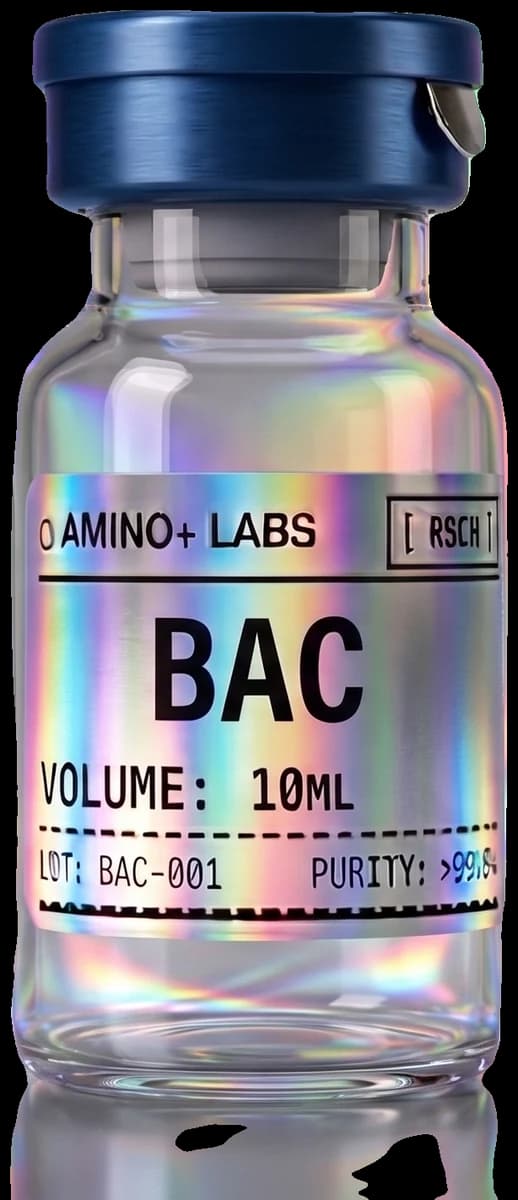
Molecular Data
- Class
- Sterile preserved diluent / USP compendial reagent (not a peptide)
- Molecular Weight
- 18.02 Da (water)
- Molecular Formula
- H₂O with 0.9% (w/v) benzyl alcohol (C₇H₈O) as preservative
- Half-Life
- Not applicable — a diluent, not an administered active compound
Mechanism of Action
Bacteriostatic water is a reagent, not an active compound, and it has no pharmacology of its own. What it has is a preservative mechanism, and that is the reason it exists as a separate product from sterile water.
- Benzyl alcohol as a bacteriostat: The 0.9% benzyl alcohol content inhibits bacterial growth rather than killing organisms outright — bacteriostatic, not bactericidal. It disrupts membrane integrity and interferes with membrane transport in susceptible organisms.
- Why that matters for a multi-use vial: Plain sterile water is sterile only until the stopper is first pierced. The preservative is what allows a reconstituted vial to be entered repeatedly over a period of days or weeks without supporting microbial growth between entries.
- No effect on the solute: Benzyl alcohol is chemically inert toward the peptides it is used to reconstitute at these concentrations. Peptide degradation in a reconstituted vial is driven by temperature, agitation, pH and freeze-thaw cycles, not by the preservative.
- The known toxicity limit: Benzyl alcohol is not universally benign. Gershanik and colleagues described a fatal "gasping syndrome" in neonates exposed to benzyl-alcohol-preserved flush solutions, which is why bacteriostatic preparations carry an explicit contraindication in newborns and why the total benzyl alcohol load matters when large volumes are involved.
Practical handling: reconstitute by directing the stream down the vial wall rather than onto the lyophilised cake, swirl rather than shake, and store reconstituted material refrigerated.
Research History
Bacteriostatic Water for Injection is a compendial article with a United States Pharmacopeia monograph, not a research compound with a discovery narrative. Its history is the history of multi-dose parenteral packaging: once a container was intended for more than one entry, a preservative became necessary, and benzyl alcohol became the common choice for aqueous diluents.
The significant chapter in that history is a safety one. In 1982, Gershanik and colleagues reported in the New England Journal of Medicine that neonates receiving benzyl-alcohol-containing flush solutions developed a syndrome of metabolic acidosis, gasping respirations, and multi-system failure. The finding led to rapid changes in neonatal practice and to the contraindication that still appears on these products.
For the purposes of this catalogue, bacteriostatic water is the companion reagent to every lyophilised peptide we supply. It is listed here for completeness of the research library, and the material is for laboratory use only.
Notable Studies
Gershanik J, Boecler B, Ensley H, McCloskey S, George W. · New England Journal of Medicine
The report that established benzyl alcohol toxicity in neonates — metabolic acidosis, gasping respirations, and multi-system failure following exposure to benzyl-alcohol-preserved solutions. The reason bacteriostatic preparations are contraindicated in newborns.