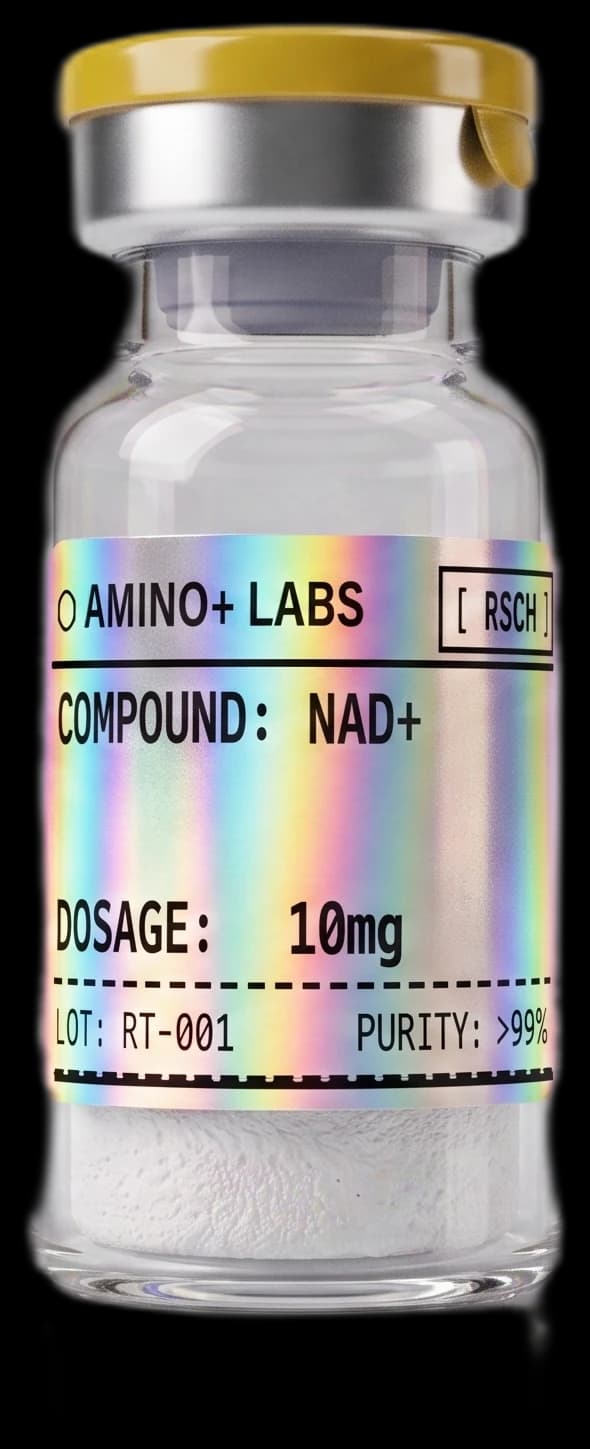
| Purity | ≥99% |
| Molecular Weight | 663.43 Da |
| Category | Nucleotide coenzyme (oxidized dinucleotide) — cellular metabolism research compound |
| Sequence | Dinucleotide (adenine nucleotide + nicotinamide nucleotide joined by a pyrophosphate bond) — not a peptide |
NAD+
An essential cellular coenzyme and substrate for sirtuins and PARP enzymes, studied for its role in energy metabolism, DNA repair, and its decline with age.
Starting from $55.00
For research use only. Not for human consumption.
Storage Conditions
Store lyophilized powder at −20 °C. After reconstitution, store at 4 °C and use within 28 days. Avoid repeated freeze-thaw cycles.
Research Overview
NAD+'s role as a metabolic redox cofactor has been established biochemistry since the early 20th century, but research interest accelerated substantially after the discovery that sirtuins — enzymes linked to caloric-restriction-associated longevity in model organisms — require NAD+ as an obligate substrate. This connected cellular NAD+ status directly to aging biology research.
Imai, Guarente, and others established that NAD+ levels decline with age across multiple tissues in animal models, and that this decline correlates with reduced sirtuin activity and impaired mitochondrial function. Cantó, Auwerx, and colleagues (2015, Cell Metabolism) reviewed the broader network of NAD+-dependent metabolic processes and the rationale for NAD+ or NAD+-precursor research.
Because directly administered NAD+ has practical limitations (poor cell permeability, rapid extracellular metabolism), much current research has shifted toward NAD+ precursor compounds — nicotinamide mononucleotide (NMN), nicotinamide riboside (NR), and others — that are more readily taken up by cells and converted to NAD+ intracellularly. Clinical research on both direct NAD+ administration (commonly via intravenous infusion in research and wellness settings) and precursor compounds is ongoing; as of current published literature, effects in healthy humans remain an active area of investigation rather than an established clinical intervention.
Research use only. This product is intended for in vitro and laboratory research purposes only. It is not approved by the FDA for human or veterinary use. It is not a drug, food, or cosmetic, and may not be misbranded, misused, or sold for purposes other than research.
All information provided is for research and educational purposes only and does not constitute medical advice.