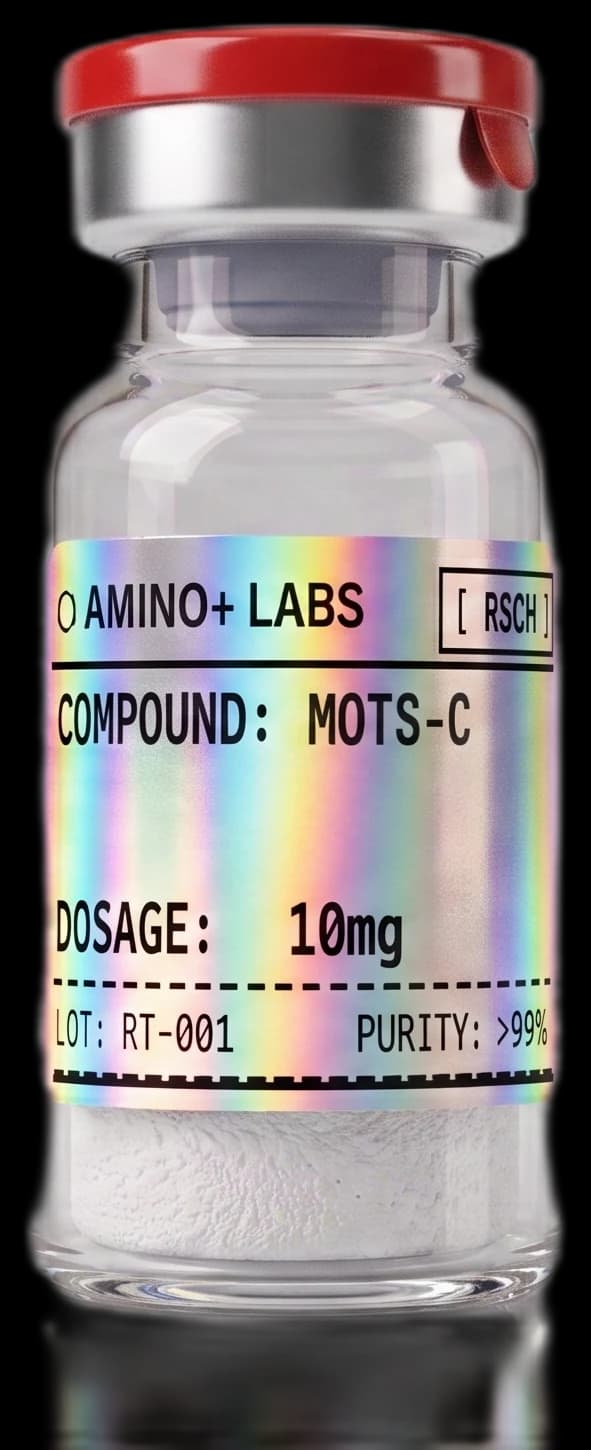
| Purity | ≥99% |
| Molecular Weight | 2,174.59 Da |
| Category | 16-amino-acid mitochondrial-derived peptide (MDP) / Metabolic regulator |
| Sequence | Met-Arg-Trp-Gln-Glu-Met-Gly-Tyr-Ile-Phe-Tyr-Pro-Arg-Lys-Leu-Arg |
MOTS-c
A 16-amino-acid, mitochondrial-DNA-encoded peptide studied as an exercise mimetic for its effects on AMPK activation and metabolic homeostasis.
Starting from $150.00
For research use only. Not for human consumption.
Storage Conditions
Store lyophilized powder at −20 °C. After reconstitution, store at 4 °C and use within 28 days. Avoid repeated freeze-thaw cycles.
Research Overview
MOTS-c was first described in 2015 by Changhan Lee and colleagues at the University of Southern California's Leonard Davis School of Gerontology, in a study published in Cell Metabolism. The discovery was notable because MOTS-c is one of only a small number of peptides now known to be encoded by mitochondrial rather than nuclear DNA.
The foundational study demonstrated that MOTS-c administration improved insulin sensitivity on euglycemic clamp testing in mice, and that sustained lower-dose administration over 8 weeks attenuated diet-induced obesity and restored glucose tolerance in a high-fat-diet model. These findings established MOTS-c's core research profile as a regulator of glucose and lipid metabolism acting through AMPK.
Subsequent research has extended into exercise physiology (MOTS-c levels rise in response to physical activity in both rodent and human studies), aging biology (age-related decline in circulating MOTS-c has been reported), and pancreatic islet cell senescence. As of the most recent published research, MOTS-c remains an investigational compound studied in preclinical and early translational settings; it has not been evaluated in large-scale human clinical trials or approved for any therapeutic use.
Research use only. This product is intended for in vitro and laboratory research purposes only. It is not approved by the FDA for human or veterinary use. It is not a drug, food, or cosmetic, and may not be misbranded, misused, or sold for purposes other than research.
All information provided is for research and educational purposes only and does not constitute medical advice.